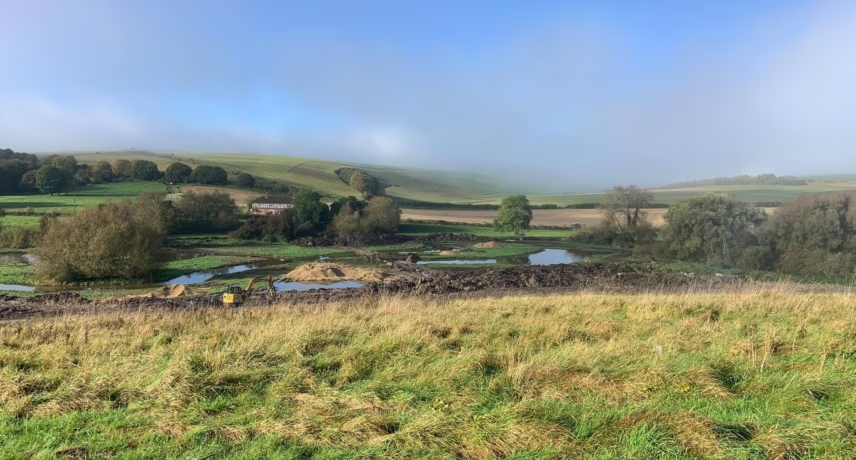


Rising Phosphate Levels in the Hampshire Avon
WWT launched the West Chisenbury project after an increase in phosphate loading in the Hampshire Avon was identified, caused in part by the redeployment of military personnel around Salisbury Plain. The Hampshire Avon is both a Site of Special Scientific Interest (SSSI) and a Special Area of Conservation (SAC)—which means an extremely careful, low-impact approach is required.
Traditional, engineered reed beds were unsuitable because they rely on concrete and other constructed infrastructure. Instead, WWT designed a wetland system for phosphate removal integrated into the river, coupled with river restoration. This innovative approach relied on accurate, reliable laboratory analyses from the very beginning.
Our role: providing analytical evidence to validate a natural wetland solution
Normec DETS provided the data WWT needed to monitor and validate the effectiveness of their wetland design. Our contribution included:
- 12 months of free water and sediment testing, allowing the project to get underway immediately.
- Rapid, reliable analysis of key parameters, including phosphorus and total organic carbon.
- Clear communication and responsive technical support to the WWT water team.
- Consistent, high-quality data suitable for modeling long-term phosphorus storage.
This early analytical baseline was essential for gaining insight into the functioning of the wetland system from day one.
Initial results: strong evidence of phosphate sequestration
The ongoing monitoring supported by Normec DETS is already yielding encouraging results:
- Increasing concentrations of phosphorus and total organic carbon in the wetland sediments, indicating successful capture of phosphate-rich suspended matter.
- Data trends confirming that the wetland is functioning as intended, without the need for artificial structures that would be out of place in the Avon’s protected landscape.
- Input for a hydrological model currently under development that will estimate total phosphorus storage over a five-year period.
Thanks to our consistent and accurate testing, WWT can confidently quantify the environmental benefits of this nature-based approach.
"We greatly appreciate the free tests that Normec DETS donated at the start of our one-year monitoring program. They also respond incredibly quickly to questions, and the results are delivered very promptly."
— Alice Eley, Head of Freshwater at Wiltshire Wildlife Trust
Result
Thanks to Normec DETS’s fast, high-quality analyses, WWT has been able to accurately measure improvements in water quality and the restoration of natural river processes. Our data continues to form the basis for the project’s long-term modeling and will help quantify the environmental benefits of this innovative approach to phosphate reduction.
Ready for the next step?
Discover how Normec Certification helps your organization demonstrate compliance with standards and regulations and prepare for tomorrow’s challenges.