
Home composting testing to international standards
Products such as coffee pods, coffee capsules, tea bags and fruit stickers are increasingly entering home compost. These products must break down completely without negatively affecting compost quality. Only then is the compost safe to use in the garden or for plants.
Normec conducts degradation and environmental safety tests for home composting. These tests can be used for certification, legal or marketing claims, and for research and product development. Home compostability standards are based on industrial composting, but differ mainly in temperature and duration of the composting process.

Our approach
Home composting takes place at ambient temperature. As a result, biodegradation is slower than in industrial composting. For certification, 90% of the organic carbon must be converted to CO₂ at 28°C within one year.
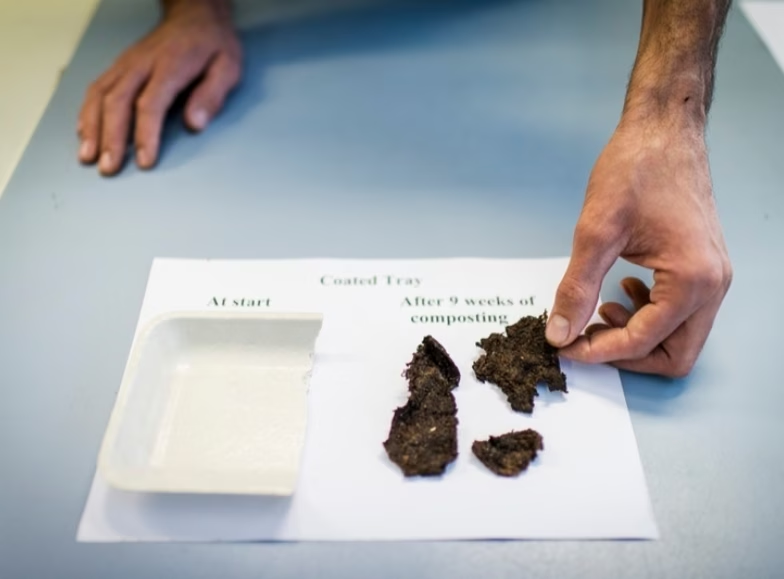
In addition to biodegradation tests, we perform disintegration tests to determine if the material physically disintegrates and visually disappears in the compost. For certification, 90% disintegration must be achieved within six months at 28°C. Because thickness, gram weight and density have a major influence on disintegration, we often test different material varieties or thicknesses first.
In addition, we perform ecotoxicity tests to assess whether compost is safe for plants and soil organisms. We also analyze heavy metals and fluorine to verify that they are within standard limits and do not adversely affect compost quality.
Testing can be performed for certification or as a screening test for product development and internal research.
Expertise in home composting and compostability testing
Normec is an independent and globally recognized laboratory for compostability testing and environmental analysis. Our home composting tests cover international and national standards, including:
- AS 5810
- NF T 51-800
- EN standards for home composting.
We are recognized by certification bodies such as:
- TÜV AUSTRIA (OK Compost Home)
- DIN CERTCO (DIN-Geprüft Home compostable)
- ABA (Home compostable)
- Other national and international certification systems
We assist organizations in conducting tests, collecting test results and preparing certification files.
Specifically, what does this mean for you?
- You demonstrate that your product is suitable for home composting
- You meet international standards and certification requirements
- You can substantiate compostability claims
- You prevent risks to compost quality and the environment
- You support product development with reliable test results
Prepared for the future
The demand for home compostable packaging and products is growing due to stricter regulations and sustainability goals. Certification and demonstrable compostability are therefore becoming increasingly important for manufacturers and packaging developers.
Through timely testing and certification, you ensure that your products meet future legislation and market requirements. This is how you work toward sustainable product development and reliable environmental claims.
Want to know more about home composting?
Project references
You might also be interested in these services


Frequently Asked Questions about home composting testing
-
Compostability means that a material is broken down into organic matter by microorganisms such as bacteria and fungi. There are two parts to this process: biodegradation and disintegration. Biodegradation occurs at the biochemical level, while disintegration means that the material physically disintegrates and visually disappears in the compost.
Compostability, however, goes beyond degradation. The material must also be safe for the environment and not adversely affect compost quality. Therefore, compostability testing consists of four major components: material properties, biodegradation, disintegration and ecotoxicity. Together, these factors determine whether a material is actually compostable according to applicable standards.
-
When a product biodegrades, carbon is converted through two processes. One part is converted into CO2 or CH4. We measure this during the biodegradation process. Another part is converted into new microbial biomass. This part cannot be measured directly and is therefore considered biomass yield.
A result of 90% biodegradation means that 90% of the carbon has been converted to CO2 or CH4 and the remaining carbon has been incorporated into microbial biomass. In practice, this means that the material has fully biodegraded and no residual material remains.
-
Normec is recognized worldwide by certification bodies. Therefore, you can take our test reports to a certification body of your choice, whether national or international.
In addition, the reports can be used for research purposes, marketing claims or legal substantiation. This depends on the test conditions and the level of quality control applied during testing.
-
Compostability tests consist of four components: material properties, biodegradation, disintegration and ecotoxicity.
-
For packaging, coffee pods, tea bags, labels, inks, adhesives, coatings and additives, among others.
-
Yes, Normec's reports can be used worldwide for certification, marketing claims, research and legal substantiation.
-
The biggest difference is in temperature and duration of the process. Home composting is done at lower temperatures and takes longer.