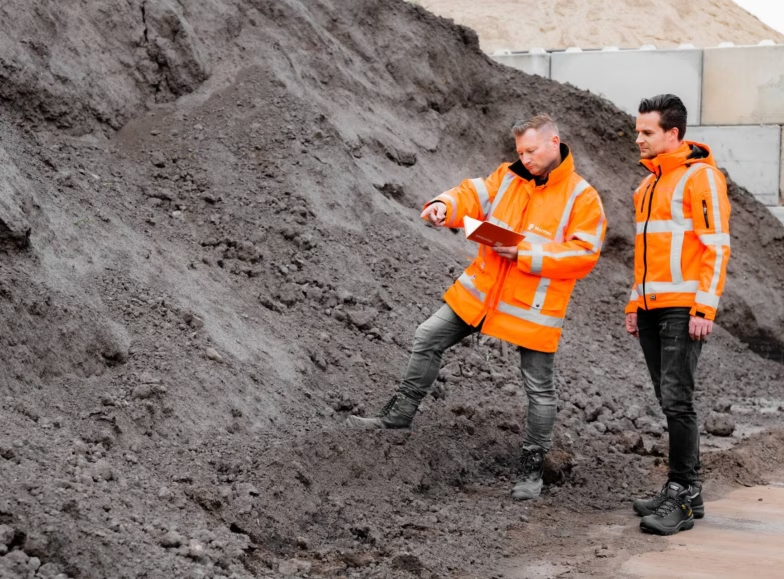


For engineering investigations
How much does a certain amount of soil, sand, or building material weigh? To determine this, the bulk density of a sample is measured.
Bulk density provides insight into the ratio between a material’s weight and the volume it occupies. This property plays a key role in construction testing, geotechnical investigations, and material quality control.

What does the bulk density of a material tell us?
Bulk density provides valuable information about a material’s properties. The results are used for technical calculations, material assessments, and estimating transport and processing volumes.
A practical example is soil transport. A truck has a certain loading capacity, but ultimately, the weight determines how much material can actually be transported. By determining the bulk density, insight is gained into the relationship between volume and weight.
The analysis is performed on, among other things:
- Soil
- Sand
- Aggregates
- Construction materials
- Recycled materials
- Other solid materials
Accurate measurement data
Accurate determination of bulk density forms the basis for reliable technical calculations and material evaluations.
Benefits of this analysis:
- You gain insight into the weight of materials per unit volume
- You have reliable data for technical calculations
- You support quality control with objective measurement results
- You can better plan transport and material flows
- You receive clear results for reports and projects

Accredited analysis according to ISO 17025 and BELAC
Our analyses are performed within an ISO 17025-accredited quality system and are covered by BELAC accreditation. This ensures you can rely on accurate, reproducible, and reliable measurement results.
Thanks to our expertise, modern laboratory equipment, and standardized procedures, the results are suitable for structural investigations, quality controls, and technical reports.
Design, execution, and quality assurance
Reliable information about bulk density helps in making informed decisions during every phase of a project—from design and preparation to execution and inspection.
By gaining insight into the properties of materials, quantities can be calculated more accurately, logistics processes can be organized more efficiently, and technical assessments can be better substantiated.
Thus, determining bulk density provides a valuable foundation for successful construction, infrastructure, transportation, and environmental projects.
Would you like to know the bulk density of a sample?
You might also be interested in these services






Frequently Asked Questions about determination of the bulk density of a sample
-
Bulk density represents the ratio between the weight of a material and the volume it occupies.
-
In practice, these terms are often used interchangeably. Both provide insight into the weight of a material per unit volume.
-
These include soil, sand, aggregates, construction materials, and recycled materials.
-
The results are used for technical calculations, quality control, transport calculations, and material evaluations.
-
For contractors, engineering firms, government agencies, manufacturers, and other organizations within the construction and infrastructure sector.
-
Yes. The analysis is performed within an ISO 17025-accredited quality system and is covered by BELAC accreditation.
-
Yes. The determination of bulk density is one of the physical tests performed within the structural engineering department at Normec