

Why is soil sampling important?
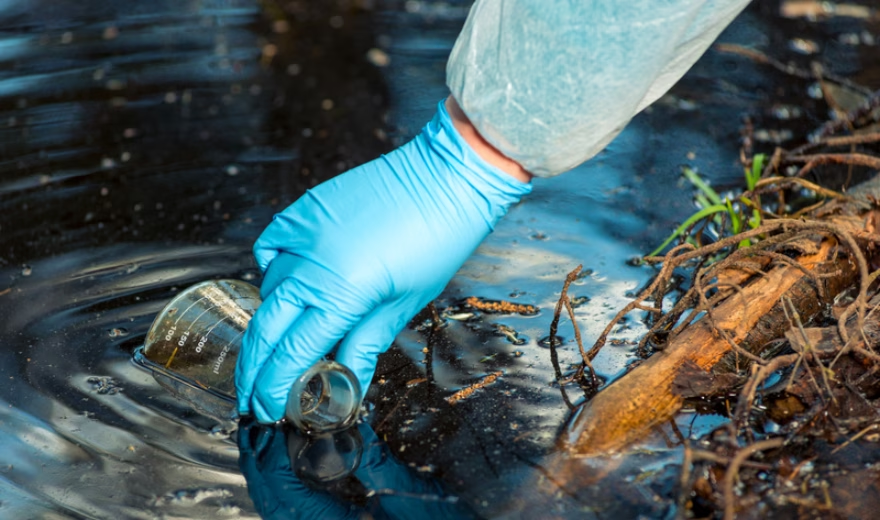
Whether it involves an environmental soil investigation, a remediation project, a permit application, or an infrastructure project, the quality of the analysis results depends directly on the quality of the sampling.
Incorrect or incomplete sampling can lead to a misleading picture of soil quality, causing risks to be overlooked or unnecessary costs to arise. That is why it is important that soil sampling is carried out according to the correct procedures and using appropriate techniques.
Normec supports industry, environmental consulting firms, government agencies, and contractors with expert manual and mechanical drilling for a wide range of soil investigations.
Tailored to your project
The choice between manual or mechanical drilling depends on the location, the desired depth, and the purpose of the investigation.
Manual drilling
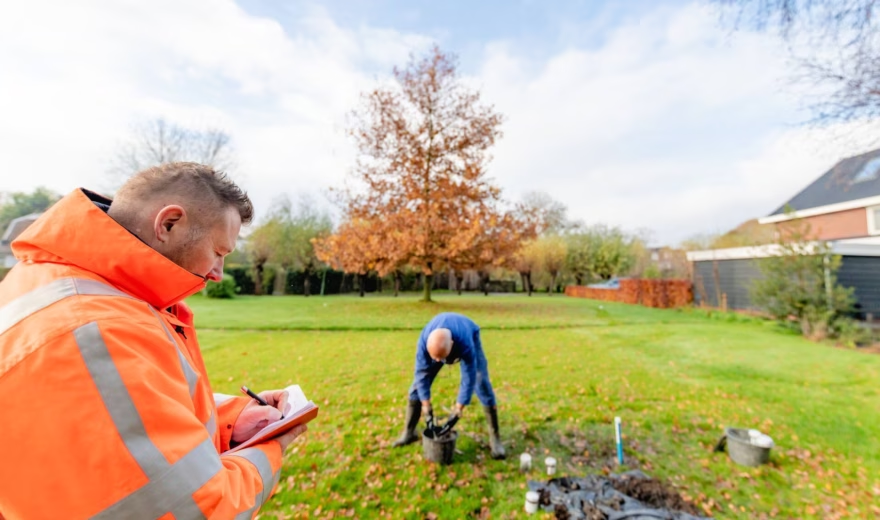
For many soil investigations, our field staff perform manual drilling using a hand auger. This method is suitable for sampling up to approximately six meters below ground level.
Even when the soil is covered with asphalt or pavement, we can first drill through the top layer to then sample the underlying soil layers.
With manual drilling, we can both:
- Take mixed soil samples
- Collect undisturbed core samples
- Sample different soil layers separately
- Visually assess soil profiles
Mechanical drilling
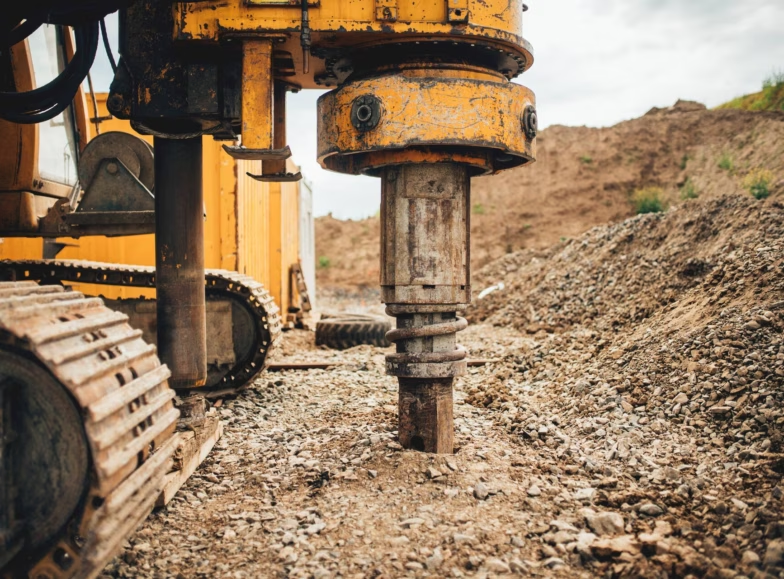
When greater depths are required, Normec uses mechanical drilling techniques. With specialized equipment, we can drill to depths of approximately twenty meters below ground level.
During these operations, our specialists take into account existing cables, pipes, high-voltage infrastructure, and other underground hazards.
Mechanical drilling offers significant advantages:
- Sampling at greater depths
- Sampling below the water table
- Greater efficiency for large-scale projects
- Collection of undisturbed soil samples
Reliable soil data for decision-making
Professional soil sampling provides the baseline data for environmental analyses, risk assessments, and further decision-making.
Here’s what this means for your organization:
- You have access to representative soil samples
- You receive reliable results for soil investigations
- You prevent errors caused by improper sampling
- You can accurately assess soil quality
- You meet the requirements of clients and regulators
The collected samples can then be analyzed in Normec’s accredited laboratory, ensuring that the entire process is carried out under one roof.
Experienced specialist in soil sampling
Normec is an accredited and independent laboratory with extensive expertise in environmental research, sampling, and fieldwork.
Our experienced staff have the knowledge, equipment, and capacity to conduct both small-scale and large-scale soil investigations. Thanks to our combination of fieldwork and laboratory analyses, we offer efficient and reliable services.
Clients choose Normec because of:
- Years of experience in soil and environmental research
- Expert field staff
- Modern drilling and sampling equipment
- Accredited analyses
- Complete peace of mind: from sampling to reporting
Thanks to our extensive capacity, we can flexibly handle projects of varying sizes and complexity.

Prepared for future soil and environmental requirements
With professional soil sampling, you have access to the reliable information needed for permitting processes, remediation projects, and environmental assessments. This ensures you comply with current regulations and are prepared for future developments in soil and environmental management.
Would you like to learn more about manual and mechanical drilling?
You might also be interested in these services
Frequently asked questions about manual and mechanical drilling
-
Manual drilling is often used when sampling to a depth of approximately six meters below ground level is sufficient and the site is easily accessible.
-
A stirred sample consists of mixed soil material. An undisturbed sample retains the original soil structure and is often used for specific studies of soil composition and properties.
-
Mechanical drilling can generally be performed to a depth of approximately twenty meters below ground level, depending on the location and soil conditions.
-
Yes. Mechanical drilling makes it possible to take representative samples below the water table.
-
The samples are sent to the laboratory for analysis of contaminants, soil composition, and other relevant parameters.
-
Yes. Prior to mechanical drilling, we take into account any existing cables, pipes, and other underground infrastructure to ensure safe working conditions.
-
The service is used for soil investigations, environmental studies, remediation projects, infrastructure works, permitting processes, and site developments.