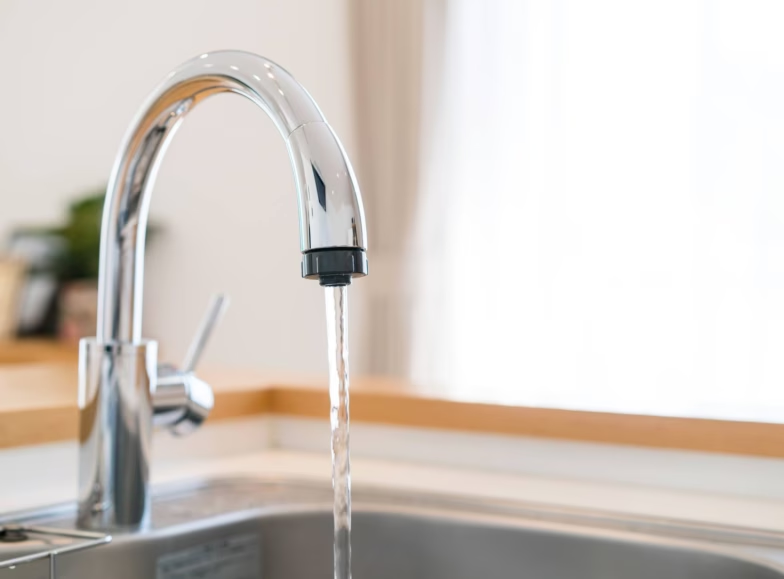


Monitoring and Detecting 1,2,4-Triazole in Water
1,2,4-triazole is currently a major focus of attention. Are you already prepared to monitor this parameter? 1,2,4-triazole is a small, polar compound that can form, among other ways, as a degradation product of various triazole-containing fungicides. Due to the compound’s mobility, it can end up in surface water and groundwater, making it relevant to drinking water production.
Analysis in Various Water Matrices
With a targeted 1,2,4-triazole analysis, you can detect the substance, gain insight into its presence, and track trends over time. Normec analyzes triazole in various water matrices. For 1,2,4-triazole in drinking water, surface water, and groundwater, we offer a limit of detection (LOD) of 20 ng/L; for 1,2,4-triazole in wastewater, the LOD is 100 ng/L.
| Water Matrix | LOD |
| Drinking Water | 20 ng/L |
| Surface water | 20 ng/L |
| Groundwater | 20 ng/L |
| Wastewater | 100 ng/L |
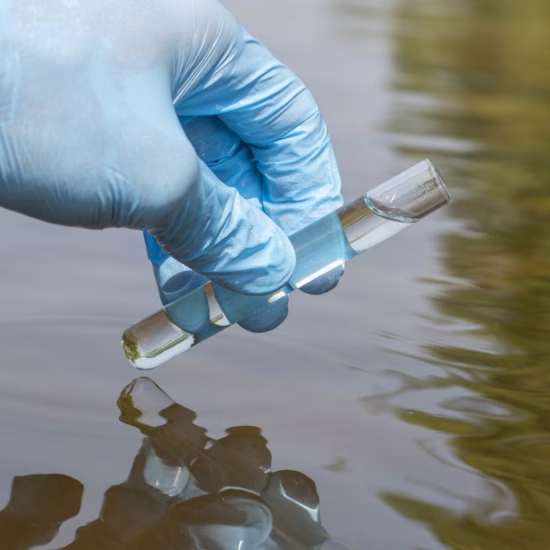
1,2,4-triazole analysis by LC-MS/MS
To determine 1,2,4-triazole, Normec uses liquid chromatography coupled with tandem mass spectrometry (LC-MS/MS). This technique combines chromatographic separation with selective mass spectrometric detection. This allows us to detect 1,2,4-triazole at low concentration levels in various water matrices.
Our analytical method is suitable for:
-
1.
1,2,4-triazole in wastewater – LOD 100 ng/L
For the control and monitoring of industrial wastewater and other relevant wastewater streams.
-
2.
1,2,4-triazole in drinking water – LOD 20 ng/L
For monitoring drinking water and water intended for drinking water production.
-
3.
1,2,4-triazole in surface water – LOD 20 ng/L
For monitoring rivers, canals, lakes, and other surface waters.
-
4.
1,2,4-triazole in groundwater – LOD 20 ng/L
For monitoring groundwater and investigating potential dispersion.
This analysis thus forms the basis for reliable monitoring and provides you with measurement data that you can use to take targeted next steps.
Gain insight and track developments
By specifically monitoring 1,2,4-triazole and comparing results, you gain greater insight into potential sources, distribution, and trends over time.
Monitoring 1,2,4-triazole helps you:
- Determine the presence of 1,2,4-triazole in your water
- Track concentrations in various watercourses
- Investigate potential sources and pathways of distribution
- Monitor surface and groundwater in a targeted manner
- Support water quality research with measurement data
- To identify trends and changes over time
1,2,4-triazole analysis for your organization
The reason for analyzing or monitoring 1,2,4-triazole varies by organization. The water matrix and your research question determine which approach is most appropriate.
Drinking Water Utilities
Monitor 1,2,4-triazole in drinking water and water intended for drinking water production. With a LOD of 20 ng/L, you can detect the substance at low concentration levels and track trends.
Industry and wastewater producers
Gain insight into 1,2,4-triazole in wastewater. Use the analysis for a one-time check, an investigation into potential emissions, or periodic monitoring.
Environmental and water laboratories, consulting firms, and government agencies
Have 1,2,4-triazole measured by LC-MS/MS in surface water and groundwater. Use the results for monitoring, water quality research, and investigations into potential dispersion.
An analysis may be relevant, for example, if:
-
1.
You want to know if 1,2,4-triazole is present
Start with a baseline measurement and gain insight into the current situation.
-
2.
You suspect a source or emission
Analyze various points in the water cycle to investigate possible pathways of dispersion.
-
3.
You want to monitor developments
Monitor periodically and compare measurement results over a longer period.
-
4.
You want to track the impact of measures
Compare results before and after an intervention to highlight changes.
-
5.
You’re conducting broader water quality research
Include 1,2,4-triazole as part of your analysis program.
From baseline measurements to periodic monitoring
Normec helps you analyze 1,2,4-triazole in drinking water, groundwater, surface water, and wastewater. From an initial baseline measurement to periodic monitoring: together, we’ll determine the approach that best suits your situation.
Would you like to know if 1,2,4-triazole is present in your water?
Send us your matrix and desired analysis.
We’ll advise you on sampling, analysis, and reporting.
You might also be interested in these services



Frequently asked questions about 1,2,4-triazole analysis in water
-
1,2,4-triazole is a small, polar compound that can be formed, among other ways, during the degradation of various triazole-containing fungicides. Due to the substance’s mobility, it can enter the aquatic environment.
-
A 1,2,4-triazole analysis helps you determine whether the substance is present. By conducting periodic measurements, you can also monitor trends and investigate potential pathways of dispersal.
-
Yes. The limit of detection (LOD) for 1,2,4-triazole in drinking water is 20 ng/L.
-
Yes. Normec analyzes 1,2,4-triazole in groundwater using LC-MS/MS. The LOD for this is 20 ng/L.
-
Yes. We analyze 1,2,4-triazole in wastewater using LC-MS/MS. The LOD for wastewater is 100 ng/L.
-
We use LC-MS/MS: liquid chromatography coupled with tandem mass spectrometry. This technique combines chromatographic separation with selective mass spectrometric detection.
-
Monitoring is useful if you want to know how the presence of 1,2,4-triazole is changing over time. By comparing results from different time points or locations, you gain insight into changes that you can then track specifically.